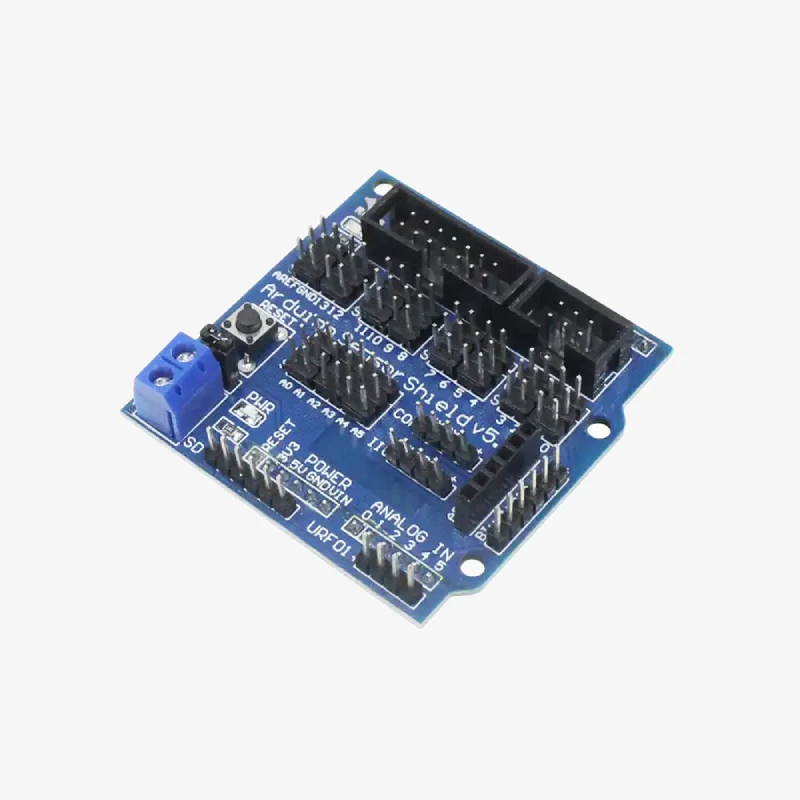
Sensor Shield V5 Expansion Board For Arduino Uno
The Sensor Shield V5 is a plug-and-play expansion board designed to simplify connecting sensors, servos, and other devices to your Arduino uno projects. Its modular design makes it perfect for prototyping and learning.
Features
- Plug-and-Play Ports: Easily connect sensors, servos, and modules without complex wiring.
- Standardized Interfaces: Includes 3-pin (GND, VCC, Signal) and 4-pin (I2C) connectors.
- Wide Compatibility: Works with Arduino Uno, Mega, and other similar boards.
- I2C and UART Support: Provides additional interfaces for communication with peripherals.
- Servo Headers: Dedicated connections for up to 16 servos.
- Reset Button: Integrated reset button for quick troubleshooting.
Specifications
- Voltage Input: 5V (powered via Arduino or external source).
- Dimensions: Standard Arduino shield size for seamless stacking.
- Connectivity: Compatible with a wide range of sensors and modules.
- Applications: Robotics, IoT, automation, and educational projects.
Pinout:
-
Power Pins:
- VCC: Power supply (5V from Arduino)
- GND: Ground
-
Digital Pins (0 to 13):
- These pins are used for connecting digital sensors and actuators. Digital pins on the shield map directly to the digital pins on the Arduino UNO.
- D0 - D13: Digital I/O pins for sensors, switches, or actuators.
-
PWM Pins (3, 5, 6, 9, 10, 11):
- These pins are used for devices that require Pulse Width Modulation (PWM) signals, such as motors, LEDs, and servos.
- PWM Pins: D3, D5, D6, D9, D10, D11
-
Analog Pins (A0 to A5):
- These pins are used for analog sensors like temperature or light sensors, providing an analog voltage signal that can be read by the Arduino.
- A0 - A5: Analog input pins.
-
I2C Pins:
- SDA (A4): Serial Data Line for I2C communication.
- SCL (A5): Serial Clock Line for I2C communication.
-
Serial Communication Pins (for Debugging):
- TX (D1): Transmit data for serial communication.
- RX (D0): Receive data for serial communication.
-
Relay Pins (Relay Module Support):
- The shield come with relay pins for controlling relays directly.
- Relay Pins: D8, D7, D6
-
Motor Driver Pins:
- The shield often includes dedicated pins for connecting motor drivers like the L298 or other motor control boards.
- Motor Pins: D12, D13
The Sensor Shield V5 is a plug-and-play expansion board designed to simplify connecting sensors, servos, and other devices to your Arduino uno projects. Its modular design makes it perfect for prototyping and learning.
Features
- Plug-and-Play Ports: Easily connect sensors, servos, and modules without complex wiring.
- Standardized Interfaces: Includes 3-pin (GND, VCC, Signal) and 4-pin (I2C) connectors.
- Wide Compatibility: Works with Arduino Uno, Mega, and other similar boards.
- I2C and UART Support: Provides additional interfaces for communication with peripherals.
- Servo Headers: Dedicated connections for up to 16 servos.
- Reset Button: Integrated reset button for quick troubleshooting.
Specifications
- Voltage Input: 5V (powered via Arduino or external source).
- Dimensions: Standard Arduino shield size for seamless stacking.
- Connectivity: Compatible with a wide range of sensors and modules.
- Applications: Robotics, IoT, automation, and educational projects.
Pinout:
-
Power Pins:
- VCC: Power supply (5V from Arduino)
- GND: Ground
-
Digital Pins (0 to 13):
- These pins are used for connecting digital sensors and actuators. Digital pins on the shield map directly to the digital pins on the Arduino UNO.
- D0 - D13: Digital I/O pins for sensors, switches, or actuators.
-
PWM Pins (3, 5, 6, 9, 10, 11):
- These pins are used for devices that require Pulse Width Modulation (PWM) signals, such as motors, LEDs, and servos.
- PWM Pins: D3, D5, D6, D9, D10, D11
-
Analog Pins (A0 to A5):
- These pins are used for analog sensors like temperature or light sensors, providing an analog voltage signal that can be read by the Arduino.
- A0 - A5: Analog input pins.
-
I2C Pins:
- SDA (A4): Serial Data Line for I2C communication.
- SCL (A5): Serial Clock Line for I2C communication.
-
Serial Communication Pins (for Debugging):
- TX (D1): Transmit data for serial communication.
- RX (D0): Receive data for serial communication.
-
Relay Pins (Relay Module Support):
- The shield come with relay pins for controlling relays directly.
- Relay Pins: D8, D7, D6
-
Motor Driver Pins:
- The shield often includes dedicated pins for connecting motor drivers like the L298 or other motor control boards.
- Motor Pins: D12, D13
Original: $0.89
-65%$0.89
$0.31Description
The Sensor Shield V5 is a plug-and-play expansion board designed to simplify connecting sensors, servos, and other devices to your Arduino uno projects. Its modular design makes it perfect for prototyping and learning.
Features
- Plug-and-Play Ports: Easily connect sensors, servos, and modules without complex wiring.
- Standardized Interfaces: Includes 3-pin (GND, VCC, Signal) and 4-pin (I2C) connectors.
- Wide Compatibility: Works with Arduino Uno, Mega, and other similar boards.
- I2C and UART Support: Provides additional interfaces for communication with peripherals.
- Servo Headers: Dedicated connections for up to 16 servos.
- Reset Button: Integrated reset button for quick troubleshooting.
Specifications
- Voltage Input: 5V (powered via Arduino or external source).
- Dimensions: Standard Arduino shield size for seamless stacking.
- Connectivity: Compatible with a wide range of sensors and modules.
- Applications: Robotics, IoT, automation, and educational projects.
Pinout:
-
Power Pins:
- VCC: Power supply (5V from Arduino)
- GND: Ground
-
Digital Pins (0 to 13):
- These pins are used for connecting digital sensors and actuators. Digital pins on the shield map directly to the digital pins on the Arduino UNO.
- D0 - D13: Digital I/O pins for sensors, switches, or actuators.
-
PWM Pins (3, 5, 6, 9, 10, 11):
- These pins are used for devices that require Pulse Width Modulation (PWM) signals, such as motors, LEDs, and servos.
- PWM Pins: D3, D5, D6, D9, D10, D11
-
Analog Pins (A0 to A5):
- These pins are used for analog sensors like temperature or light sensors, providing an analog voltage signal that can be read by the Arduino.
- A0 - A5: Analog input pins.
-
I2C Pins:
- SDA (A4): Serial Data Line for I2C communication.
- SCL (A5): Serial Clock Line for I2C communication.
-
Serial Communication Pins (for Debugging):
- TX (D1): Transmit data for serial communication.
- RX (D0): Receive data for serial communication.
-
Relay Pins (Relay Module Support):
- The shield come with relay pins for controlling relays directly.
- Relay Pins: D8, D7, D6
-
Motor Driver Pins:
- The shield often includes dedicated pins for connecting motor drivers like the L298 or other motor control boards.
- Motor Pins: D12, D13