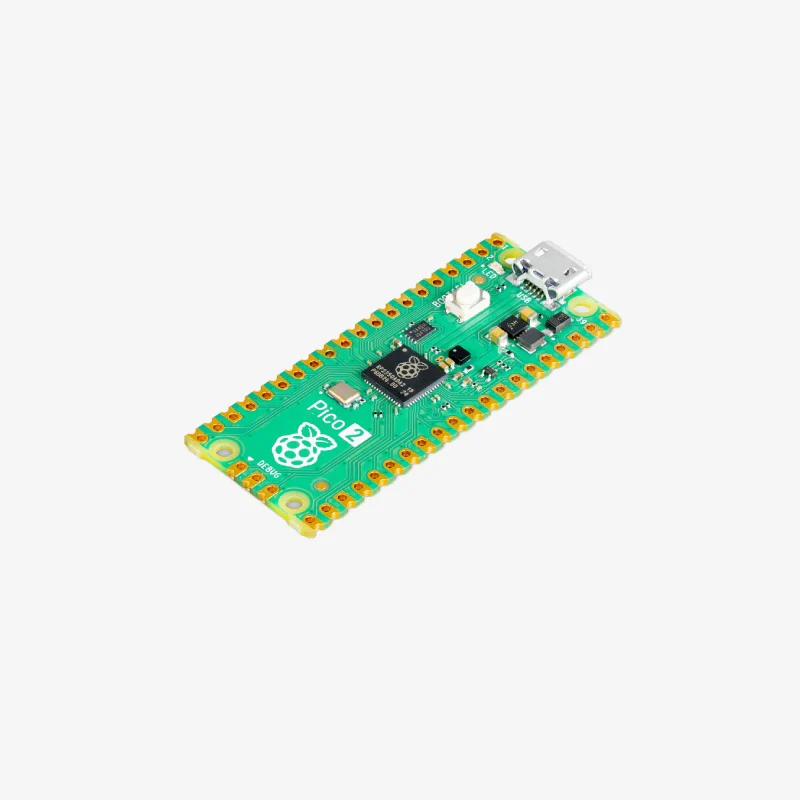
Raspberry Pi Pico 2
The Raspberry Pi Pico 2 takes microcontroller performance to the next level, offering a higher core clock speed, double the memory, and enhanced processing power. With upgraded Arm cores, optional RISC-V cores, advanced security features, and improved interfacing capabilities, the Pico 2 is backward-compatible with earlier Raspberry Pi Pico boards while providing significant enhancements for both enthusiasts and professional developers.
Powered by the RP2350 microcontroller, the Pico 2 delivers unparalleled performance and flexibility. Featuring dual-core, dual-architecture processing, it allows developers to explore both Arm Cortex-M33 and Hazard3 RISC-V cores, offering the best of both worlds in a secure and stable environment.
Programmable in C/C++ and Python with extensive documentation, the Pico 2 is designed to support a wide range of applications, from hobby projects to professional deployments.
Features
- Dual-core processing: Choose between Arm Cortex-M33 cores and Hazard3 RISC-V cores, both clocked at 150MHz
- Backward-compatible with Raspberry Pi Pico 1 for seamless upgrades
- Drag-and-drop programming via USB mass storage
- Castellated module design for direct soldering to carrier boards
- Comprehensive security features, including:
- ARM TrustZone for Cortex-M
- Optional boot signing with key fingerprint in OTP
- Global bus filtering and periphery security domain assignment
- Hardware fault injection mitigations and SHA-256 accelerator
Specifications
- Memory: 520 KB on-chip SRAM
-
Interfaces:
- 2 × UART
- 2 × SPI controllers
- 2 × I2C controllers
- 24 × PWM channels
- 3 × ADC channels
- 1 × USB 1.1 controller and PHY (host and device support)
- 12 × PIO state machines
- Power: Input voltage range 1.8–5.5V DC
- Operating Temperature: -20°C to +85°C
Software Support
- Open source C/C++ SDK
- MicroPython support
Browse our full Raspberry Pi Collection including development boards, camera modules, displays, power supplies, HATs, and accessories designed for IoT, automation, robotics, and embedded systems.
The Raspberry Pi Pico 2 takes microcontroller performance to the next level, offering a higher core clock speed, double the memory, and enhanced processing power. With upgraded Arm cores, optional RISC-V cores, advanced security features, and improved interfacing capabilities, the Pico 2 is backward-compatible with earlier Raspberry Pi Pico boards while providing significant enhancements for both enthusiasts and professional developers.
Powered by the RP2350 microcontroller, the Pico 2 delivers unparalleled performance and flexibility. Featuring dual-core, dual-architecture processing, it allows developers to explore both Arm Cortex-M33 and Hazard3 RISC-V cores, offering the best of both worlds in a secure and stable environment.
Programmable in C/C++ and Python with extensive documentation, the Pico 2 is designed to support a wide range of applications, from hobby projects to professional deployments.
Features
- Dual-core processing: Choose between Arm Cortex-M33 cores and Hazard3 RISC-V cores, both clocked at 150MHz
- Backward-compatible with Raspberry Pi Pico 1 for seamless upgrades
- Drag-and-drop programming via USB mass storage
- Castellated module design for direct soldering to carrier boards
- Comprehensive security features, including:
- ARM TrustZone for Cortex-M
- Optional boot signing with key fingerprint in OTP
- Global bus filtering and periphery security domain assignment
- Hardware fault injection mitigations and SHA-256 accelerator
Specifications
- Memory: 520 KB on-chip SRAM
-
Interfaces:
- 2 × UART
- 2 × SPI controllers
- 2 × I2C controllers
- 24 × PWM channels
- 3 × ADC channels
- 1 × USB 1.1 controller and PHY (host and device support)
- 12 × PIO state machines
- Power: Input voltage range 1.8–5.5V DC
- Operating Temperature: -20°C to +85°C
Software Support
- Open source C/C++ SDK
- MicroPython support
Browse our full Raspberry Pi Collection including development boards, camera modules, displays, power supplies, HATs, and accessories designed for IoT, automation, robotics, and embedded systems.
Original: $4.76
-65%$4.76
$1.67Description
The Raspberry Pi Pico 2 takes microcontroller performance to the next level, offering a higher core clock speed, double the memory, and enhanced processing power. With upgraded Arm cores, optional RISC-V cores, advanced security features, and improved interfacing capabilities, the Pico 2 is backward-compatible with earlier Raspberry Pi Pico boards while providing significant enhancements for both enthusiasts and professional developers.
Powered by the RP2350 microcontroller, the Pico 2 delivers unparalleled performance and flexibility. Featuring dual-core, dual-architecture processing, it allows developers to explore both Arm Cortex-M33 and Hazard3 RISC-V cores, offering the best of both worlds in a secure and stable environment.
Programmable in C/C++ and Python with extensive documentation, the Pico 2 is designed to support a wide range of applications, from hobby projects to professional deployments.
Features
- Dual-core processing: Choose between Arm Cortex-M33 cores and Hazard3 RISC-V cores, both clocked at 150MHz
- Backward-compatible with Raspberry Pi Pico 1 for seamless upgrades
- Drag-and-drop programming via USB mass storage
- Castellated module design for direct soldering to carrier boards
- Comprehensive security features, including:
- ARM TrustZone for Cortex-M
- Optional boot signing with key fingerprint in OTP
- Global bus filtering and periphery security domain assignment
- Hardware fault injection mitigations and SHA-256 accelerator
Specifications
- Memory: 520 KB on-chip SRAM
-
Interfaces:
- 2 × UART
- 2 × SPI controllers
- 2 × I2C controllers
- 24 × PWM channels
- 3 × ADC channels
- 1 × USB 1.1 controller and PHY (host and device support)
- 12 × PIO state machines
- Power: Input voltage range 1.8–5.5V DC
- Operating Temperature: -20°C to +85°C
Software Support
- Open source C/C++ SDK
- MicroPython support
Browse our full Raspberry Pi Collection including development boards, camera modules, displays, power supplies, HATs, and accessories designed for IoT, automation, robotics, and embedded systems.